
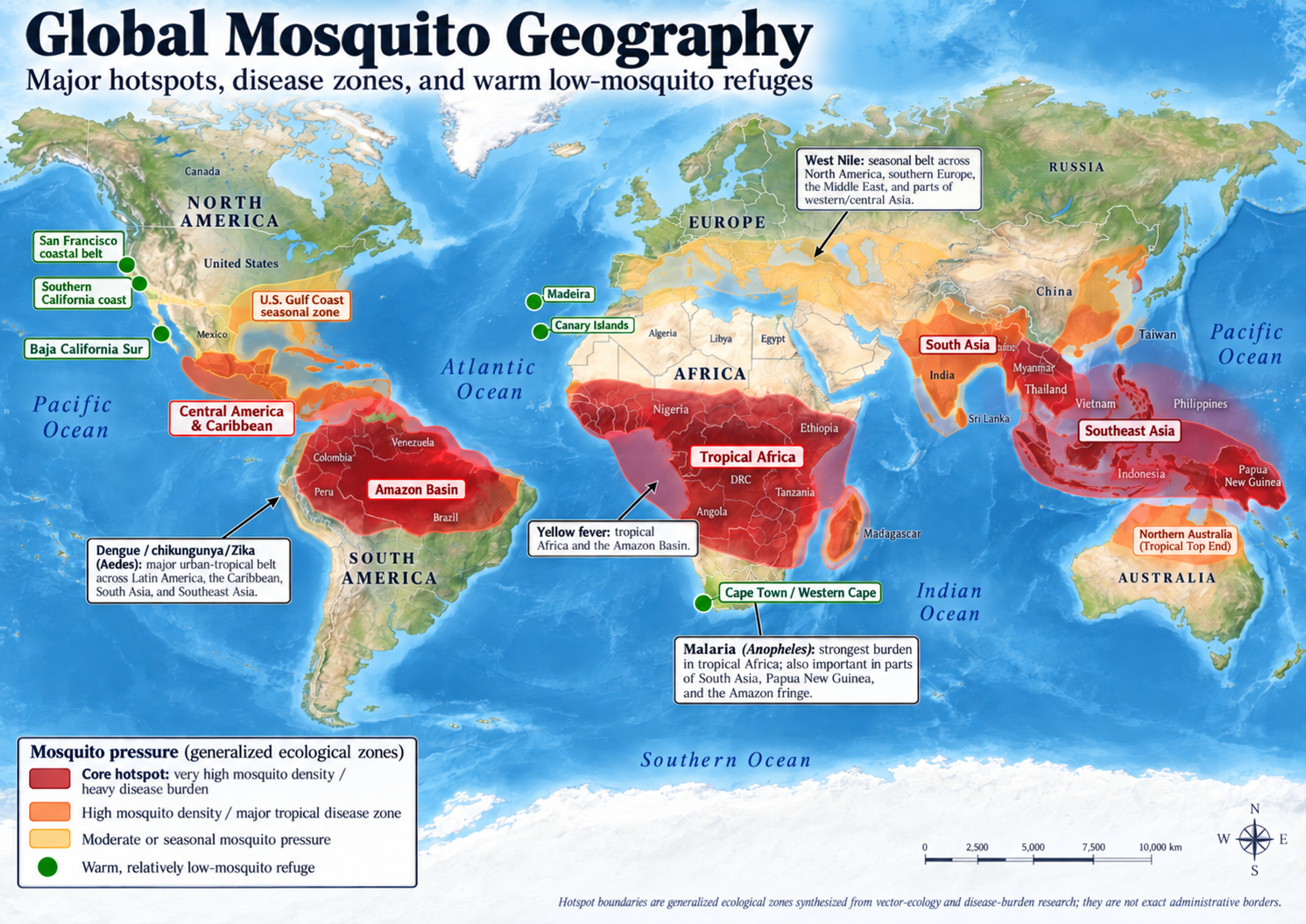

Warm Countries With Fewer Mosquitoes: The Best Places to Live for Sunshine, Comfort and Outdoor Living
Discover beautiful warm-weather destinations where the climate may help reduce mosquito nuisance, and learn what to look for when buying a luxury home, family residence or holiday property.
Imagine owning a beautiful coastal home where you can enjoy breakfast on the terrace, watch the sunset with friends and let your children play in the garden. The weather is warm, the surroundings are spectacular and outdoor living is part of everyday life.
For many people relocating abroad or buying a second home, this is the dream. However, one factor is often overlooked when choosing the ideal destination: mosquitoes.
While many tropical destinations offer extraordinary scenery and warm temperatures, some also experience substantial mosquito populations. This can make evening dining, gardening, outdoor entertaining and family activities less enjoyable.
Mosquitoes can also transmit diseases, including malaria, dengue, chikungunya, Zika and yellow fever, depending on the destination.
Fortunately, not every warm-weather destination experiences the same mosquito conditions.
Some regions benefit from relatively dry summers, coastal winds, lower humidity or cooler evenings. These characteristics can make certain locations more appealing for people who want sunshine without the mosquito nuisance associated with many humid tropical environments.
At African Land, we believe choosing the right property means considering more than architecture, location and investment potential. The surrounding environment and everyday quality of life matter just as much.
This guide explores six destinations worth considering, explains where mosquitoes are most prevalent, and highlights how thoughtful property selection and design can create a more comfortable lifestyle.
Why Do Some Warm Countries Have More Mosquitoes Than Others?
Mosquitoes are found across much of the world, including tropical, subtropical and temperate regions. Their abundance depends on more than temperature alone.
Most mosquito species require water to complete their early development. Depending on the species, breeding habitats may include wetlands, flooded fields, ponds, drainage systems, rainwater containers and even small amounts of water trapped around homes.
Several environmental factors influence mosquito populations:
-
Rainfall: Rain can create temporary breeding habitats, while prolonged drought may reduce some natural mosquito populations.
-
Humidity: Humid conditions can improve adult mosquito survival, although the relationship varies by species.
-
Temperature: Warm conditions can accelerate mosquito development within suitable limits.
-
Standing water: Poor drainage, uncovered water tanks and containers can support breeding, even in otherwise dry regions.
-
Vegetation: Sheltered, shaded gardens can create favourable resting habitats.
-
Coastal exposure: Strong winds and exposed conditions may reduce mosquito activity in certain locations.
Importantly, warm regions with relatively dry Mediterranean or desert climates can sometimes offer a more comfortable outdoor experience than humid tropical areas.
However, climate is only part of the picture. Two properties in the same town can experience very different mosquito conditions because of their gardens, nearby water sources and maintenance arrangements.
Six Warm-Weather Destinations Worth Exploring
The following destinations combine attractive lifestyles, established residential markets and climate characteristics that may be advantageous in selected locations.
They are not a scientifically proven ranking of the world's lowest-mosquito destinations. Mosquito abundance varies locally and seasonally, and some of these places have established disease-vector populations.
1. Cape Town and the Western Cape, South Africa
Best for: Luxury coastal living, family homes, outdoor lifestyles and spectacular scenery.
Cape Town is one of the most appealing destinations for people looking to combine beautiful weather with sophisticated coastal living.
Located at the southwestern tip of Africa, the city enjoys a Mediterranean climate characterised by warm, generally dry summers and cooler, wetter winters.
Unlike many humid tropical regions, Cape Town experiences relatively low summer rainfall. Coastal exposure and seasonal winds can also make certain neighbourhoods feel particularly pleasant.
The Western Cape offers an exceptional variety of residential environments, from contemporary oceanfront apartments to prestigious hillside villas and family homes surrounded by mountain scenery.
Popular residential locations include Clifton, Camps Bay, Bantry Bay, Fresnaye, Constantia and selected areas of the Atlantic Seaboard.
What about mosquitoes?
Mosquitoes are present in Cape Town, particularly near standing water, sheltered gardens and suitable breeding habitats. However, the region's Mediterranean climate differs substantially from the humid tropical conditions associated with some of Africa's heaviest mosquito populations.
The Western Cape is also outside South Africa's principal malaria-transmission areas, which are concentrated in parts of the country's northeastern regions.
This does not mean Cape Town is mosquito-free or that every neighbourhood experiences low mosquito activity.
For property buyers, the most sensible approach is to investigate individual locations, garden conditions and seasonal mosquito nuisance.
Property buying tip: Look for well-drained gardens, reliable water management, properly screened bedrooms and sheltered outdoor areas that can be comfortably used throughout the year.
For buyers interested in African coastal property, African Land provides a starting point for exploring residential opportunities and property investment.
2. San Francisco and the California Coast, United States
Best for: Coastal city living, professional families and buyers who prefer mild rather than tropical weather.
San Francisco offers a distinctive climate compared with most destinations associated with warm-weather living.
Its position beside the Pacific Ocean creates mild temperatures, coastal winds and frequent summer fog. The city's summers are generally much cooler than those in inland California.
These conditions can make some exposed coastal neighbourhoods less favourable to mosquito activity than warmer, wetter environments.
However, San Francisco should not be confused with the entire Bay Area.
Inland communities can experience substantially higher summer temperatures, while wetlands, urban drainage and irrigated gardens may support mosquito populations.
The wider region also conducts mosquito surveillance because of diseases such as West Nile virus.
For international property buyers, San Francisco offers world-class amenities, attractive architecture, established residential neighbourhoods and access to coastal recreational activities.
Property buying tip: Compare individual neighbourhoods rather than assuming all coastal and inland communities experience the same mosquito conditions. Request information from the relevant local mosquito and vector-control district.
3. The Canary Islands, Spain
Best for: Year-round mild weather, island living and European second homes.
The Canary Islands are an appealing option for people who want consistent sunshine without the extreme heat and humidity of many tropical destinations.
Situated off the northwestern coast of Africa, the archipelago includes Tenerife, Gran Canaria, Lanzarote, Fuerteventura and several smaller islands.
The islands enjoy subtropical climates moderated by the Atlantic Ocean. Many coastal communities experience relatively mild winters and warm, sunny summers.
Some of the drier districts, particularly in the eastern islands, offer desert-like landscapes and limited natural surface water.
These conditions can make certain locations worth investigating for people concerned about mosquito nuisance.
Nevertheless, mosquitoes do occur in the Canary Islands, and invasive Aedes species have been detected and monitored in parts of the archipelago.
Local water storage, irrigation and urban environments can provide breeding opportunities even where natural rainfall is limited.
Property buying tip: Investigate neighbourhood-specific mosquito information, particularly in developments with extensive landscaping, swimming pools, decorative fountains or irrigation systems.
4. Madeira, Portugal
Best for: Scenic island properties, retirement living and comfortable year-round temperatures.
Madeira has become increasingly attractive to international buyers seeking picturesque surroundings, a relaxed lifestyle and a comparatively mild climate.
Its volcanic landscapes, ocean views and established residential communities provide appealing options for both permanent relocation and second-home ownership.
Temperatures are moderated by the Atlantic Ocean, making the island attractive to people who prefer warmth without prolonged extreme heat.
Madeira's topography creates significant local climate differences. Some coastal areas are relatively dry and sunny, while higher elevations and exposed mountain areas can be considerably wetter.
What about mosquitoes?
Madeira is an important reminder that pleasant island weather does not necessarily mean low mosquito risk.
The island has an established population of Aedes aegypti, a mosquito capable of transmitting dengue and several other viruses. Madeira experienced a dengue outbreak in 2012.
Consequently, Madeira should not be described as mosquito-free or assumed to have exceptionally low mosquito density.
Nevertheless, its lifestyle advantages may still appeal to buyers who are prepared to investigate local mosquito conditions and implement suitable property protection.
Property buying tip: Check local public-health advisories, ensure that water storage systems are protected, and give particular attention to drainage and outdoor maintenance.
5. Baja California Sur, Mexico
Best for: Desert coastal living, luxury resorts and contemporary villas.
Baja California Sur offers a combination that is relatively unusual in the international luxury property market: dramatic desert scenery alongside spectacular coastlines.
Destinations such as Los Cabos, San José del Cabo and La Paz attract buyers interested in sunshine, ocean views, boating and luxury resort lifestyles.
Much of the region is arid, with limited rainfall compared with Mexico's humid tropical areas.
Dry conditions can restrict some natural mosquito breeding habitats, making selected coastal and desert locations worth investigating.
However, aridity does not eliminate mosquitoes.
Seasonal rainfall, tropical storms, irrigation, water storage and swimming-pool maintenance can all influence mosquito populations.
Dengue also occurs in Mexico, including in areas that experience relatively dry climates.
Property buying tip: Modern luxury developments should be assessed for effective drainage, professionally managed landscaping and water systems that do not create unnecessary breeding habitats.
6. Southern California Coast, United States
Best for: Luxury family homes, beach lifestyles and established residential communities.
Southern California offers some of the world's most recognisable coastal residential destinations.
Communities around Malibu, Santa Barbara, Newport Beach, Laguna Beach and San Diego attract buyers seeking attractive weather, ocean access and premium homes.
The region's Mediterranean climate brings dry summers and relatively mild winters, while coastal areas often benefit from cooling ocean breezes.
These qualities make Southern California appealing for year-round outdoor living.
However, mosquito conditions have changed in recent years.
Invasive Aedes mosquitoes have become established in numerous Southern California communities, including residential areas. These mosquitoes can breed in small containers and irrigated gardens and may bite during daylight hours.
Therefore, a dry climate cannot be treated as proof of low mosquito populations.
Property buying tip: Ask local vector-control authorities about recent mosquito activity and prioritise homes with appropriate screening, efficient garden drainage and professionally maintained outdoor spaces.
Comparing the Six Destinations
| Destination | Climate | Main lifestyle appeal | Mosquito considerations |
|---|---|---|---|
| Cape Town, South Africa | Mediterranean | Luxury villas, family living, coast and mountains | Mosquitoes present; seasonal and neighbourhood variation |
| San Francisco, USA | Cool maritime/Mediterranean | Coastal city living and professional communities | Generally cooler coastal conditions; wetland and inland variation |
| Canary Islands, Spain | Subtropical | Sunshine, island living and second homes | Dry districts worth exploring; invasive mosquito surveillance important |
| Madeira, Portugal | Subtropical maritime | Retirement, scenery and mild temperatures | Established Aedes aegypti and history of dengue transmission |
| Baja California Sur, Mexico | Arid to semi-arid | Desert villas, resorts and ocean activities | Seasonal rainfall, irrigation and dengue considerations |
| Southern California, USA | Mediterranean | Luxury coastal homes and family lifestyles | Established invasive Aedes mosquitoes in many communities |
The most important consideration is not simply which destination is warmest or driest. It is how the local environment, mosquito species, property design and seasonal conditions interact.
Where Are the World's Major Mosquito Hotspots?
Understanding the regions with substantial mosquito populations helps explain why apparently similar destinations can offer very different experiences.
There is no universally accepted global ranking of mosquito density. Researchers use different trapping methods, observation periods and measures of abundance.
However, several major geographical regions are particularly important because of their mosquito ecology and disease burden.
Tropical Sub-Saharan Africa
Many parts of tropical Africa provide favourable environmental conditions for important mosquito vectors.
Warm temperatures, seasonal rainfall, wetlands, river systems and agricultural landscapes can support mosquito populations, although abundance varies considerably across habitats and seasons.
The region also experiences the greatest global burden of malaria.
According to the WHO's World Malaria Report 2025, approximately 95% of global malaria deaths in 2024 occurred in the WHO African Region.
Important malaria vectors include members of the Anopheles gambiae complex and Anopheles funestus group.
Other mosquito genera, including Aedes and Culex, are relevant to additional mosquito-borne diseases.
The Amazon Basin
The Amazon's humid tropical climate, extensive river systems and forest environments support diverse mosquito communities.
Malaria persists in parts of the Amazon Basin, while dengue, yellow fever and other arboviruses are also important public-health concerns in relevant areas.
However, mosquito conditions vary between dense urban communities, forest settlements, riverine habitats and higher-elevation locations.
South and Southeast Asia
South and Southeast Asia contain major mosquito-borne disease systems associated with urban environments, agricultural landscapes, tropical forests and monsoon climates.
Dengue is a particularly important concern across numerous countries, with Aedes aegypti and Aedes albopictus playing major roles in transmission.
Malaria continues in certain endemic areas, while Japanese encephalitis is important in selected rural and agricultural settings.
Central America and the Caribbean
Warm temperatures, rainfall and urban water-storage conditions can create suitable environments for mosquito breeding across parts of Central America and the Caribbean.
Dengue is a major concern in many destinations, while chikungunya and Zika have also affected the region.
Malaria transmission persists in some locations but is absent or substantially reduced in others.
For property buyers, local disease surveillance and the immediate residential environment are more informative than broad assumptions about an entire island or country.
Does Living Somewhere Without Malaria Mean There Are Fewer Mosquitoes?
Not necessarily.
This is one of the most important distinctions for international homebuyers.
Malaria is transmitted by particular Anopheles mosquitoes when local conditions support transmission of malaria parasites.
Other mosquito genera, including Aedes and Culex, can be abundant in destinations without ongoing malaria transmission.
For example, a location may have no locally acquired malaria but still experience significant mosquito nuisance or seasonal West Nile virus concerns.
Similarly, a region that is considered low risk for mosquito-borne disease may still experience irritating mosquito bites.
When investigating a destination, consider two separate questions:
-
How frequently are residents exposed to biting mosquitoes?
-
Which mosquito-borne diseases, if any, are transmitted locally?
Both are relevant when selecting a place to live.
How to Choose a Luxury Home With Fewer Mosquito Problems
The good news for property buyers is that mosquito nuisance is not determined by geography alone.
Thoughtful design and effective property management can make a significant difference to comfort.
1. Prioritise Effective Drainage
Mosquito breeding can occur in water that accumulates around patios, gardens, roofs and drainage systems.
Before buying a property, inspect areas where rainwater or irrigation water may collect.
Pay particular attention to blocked gutters, poorly graded garden surfaces and unused containers.








Comments 0
Add new comment